ai
Opus is back

Last week I wrote that Astra was a game changer for me. I still think that. For a week it sat at the centre of how I worked, and Codex felt exciting again after a year of being ordinary.
Then Opus 5.5 came out, and by the end of this week I am back to using mostly Claude.
Astra did not get worse. The gap I was reacting to closed, and once the two models are close, the other things - the app, the cost of running it, how each one behaves on different kinds of work - decide where I spend the day. After a week of running both, the split looks like this.
Both on high
I run both models on high effort. That is my default, and most of my work happens there. For the more mainstream tasks - a small refactor, a copy change, a question about code I already understand - I switch down to medium, and sometimes to low.
The benchmark numbers match why that default works for me. This is the AutomationBench chart of pass rate against cost for each effort level:
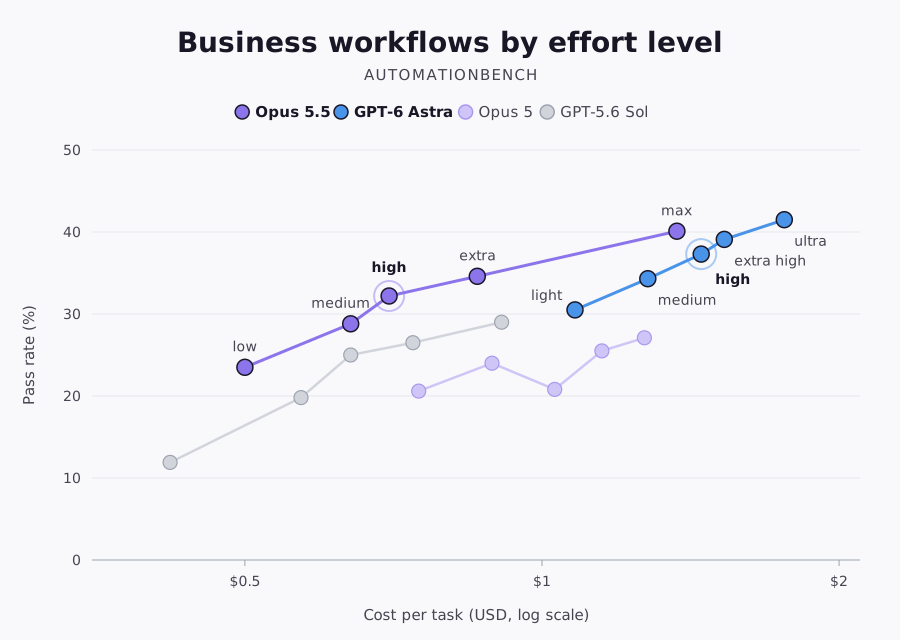
Two things stand out. The first is how far Opus 5.5 moved from Opus 5: at medium it already passes more tasks than Opus 5 did at its highest setting, and for less than Opus 5 cost at its lowest. The second is where high sits on the Opus curve. Going from low to high buys a lot, for not much more money. Going from high to max buys another eight points, but nearly doubles the cost per task. Astra's curve is higher at the top end, where ultra passes the most tasks of anything on the chart, but even light costs more per task than Opus on extra.
A benchmark is not my workday, but it lines up with what I feel: high is where the effort is still clearly paying for itself, and anything above it is for the problems that need it.
The same prompt, twice
For mock-ups I do not pick a model at all. I give both of them the same prompt, look at what comes back, and continue with whichever produced the better result.
This costs very little. A mock-up is cheap to generate and quick to judge, and the two models have different enough taste that the better one is usually obvious. There is no reason to decide in advance which one is the designer.
Where Codex is better
Codex asks me better questions. When I start something new, it feels a lot like grill-with-docs - interviewing me about the plan until we understand it the same way - except that it asks fewer questions. It gets to the ones that matter faster, and I get back to being productive sooner.
The plans it produces are good in the same way. They carry fewer details, and that makes them easier to read. I can review an Astra plan quickly and actually disagree with it, instead of skimming a document that is too long to argue with.
It is also very good at testing a flow, and the acceptance criteria it writes are great: concrete, checkable, and easy to hold the finished work against.
Where Claude is better
Claude is still more comfortable for me. The app has the features I actually use and the clean interface I want to look at all day. Worktree management is the clearest example. In Claude it is there and it works; with Codex, running several pieces of work in parallel needs additional harness setup first.
It is also better at small changes. Claude's testing flow scales down with the task. When I change one thing, it checks that one thing, rather than setting off a full, complex testing flow that is more appropriate for a feature than a fix.
And it takes fewer tokens to operate. For the same kind of work, Claude uses less of my usage than Codex does, which matters when both are open all day.
The review that found two problems
The best evidence for running both came from one piece of work this week.
I built a large piece of functionality with Astra - more than 150 files. Astra was good at it: the plan was readable, the flow was tested, and the acceptance criteria were thorough. Then I gave the whole change to Claude to review.
The review found two critical issues, either of which would have broken production.
A model reviewing its own work shares the assumptions it made while writing it, and a second model does not. After this week, I do not think of the two as competing for the same job: one of them writing and the other reviewing is better than either of them doing both.
Where that leaves me
Opus is back at the centre of my workflow: the app I have open, the model I reach for first, and the one I trust with the small changes and the final review. Astra stays for planning, testing flows, acceptance criteria, and every mock-up, where it competes with Claude on the same prompt.
A week ago I was looking forward to week two with Astra. I did not expect week two to be the week Opus came back.