ai
Thirty-six questions before the first ticket


Until this week, our sales team quoted gyms from a single HTML file. Someone built it as a claude.ai artifact: pick Run or Grow, a member tier, the number of locations and a couple of add-ons, and it prints a branded offer with a price. It works, and it lives outside the product. Nobody can see which offers went out or which were opened, and the prices in it are two hardcoded tables, keyed by language.
On Wednesday the replacement merged to main. Offers are now part of 1club. A
super admin composes one in the admin. The prospect opens it at its own link on
offers.1club.ai without an account, changes the parts we allow them to
change, watches the price follow, and accepts. If the prospect is already a
customer, the same offer can also appear inside their own admin.
The way this feature was designed was new to me, so I want to write it down.
On 25 August I installed Matt Pocock's skills
into Claude Code, and forty minutes later I ran /grill-with-docs on Offers.
The interview took two hours. By the end of the afternoon there was a glossary,
two ADRs, a spec with 75 user stories, and 16 GitHub issues with a dependency
graph between them. Four weeks later the last of them was merged.
One feature, every layer
Offers is a good test for a design process because nothing about it stays in one place:
- Product: what the prospect may change, what "accept" means when nothing is charged, and how to replace a tool that sales already likes.
- UX: a composer with a live preview, a configurator on the public page, six languages, and a page for links that no longer work.
- System design: offers and their versions, prices frozen at the moment of quoting, the URL as the identity of a version, and expiry without a background job.
- Billing: the offer quotes per location, while Stripe bills per active member.
- Infrastructure: a new Next.js app on its own Vercel project, Terraform for it, staging and promote workflows, and hosts paired per environment.
- Three portals: the super admin's, the customer's admin, and the public page.
I wrote earlier about the three pillars of a product engineer. Offers is what that looks like on a single feature. A decision in any one of these layers moves the others, so I wanted all of them made before the first line of code, and in an order where a later decision did not undo an earlier one.
What grill-with-docs is
The skill itself is one line: call the grilling skill and the
domain-modeling skill.
grillingwalks a design tree and asks questions in rounds, each with a recommended answer, until nothing is left open. It treats finding facts as its own job: anything it can look up in the code, it looks up instead of asking.domain-modelingkeeps aCONTEXT.mdglossary up to date while you talk. It writes an ADR only when a decision is hard to reverse, surprising, and a real trade-off.
My first run was a false start. I called /grill-with-docs with no arguments
in a worktree named after a check-in task, and it started grilling me about
check-in. I deleted the worktree and started over with a long opening prompt:
- Offers are for super admins and are composed by hand for now.
- The offer has interactive blocks, and the price follows the prospect's setup.
- It is hosted on
offers.1club.aiwith no login. - It has a tab in the admin between Help & updates and Notifications.
- Offers have versions and an expiry date.
- The recipient may not be an organization in 1club yet.
- The look is a branded template in the white theme.
Before asking anything, Claude spent six minutes reading. It went through the admin navigation, the Stripe plan catalog, the deploy setup and the sales team's artifact itself, all 727 KB of it. Its first message described the existing tool more precisely than I could have: every input, the formula, and the two price tables keyed by language. Only then did the questions start.
Thirty-six questions in five rounds
The questions came numbered, in five rounds, and each had a recommendation marked with an arrow. I answered most of them with "yes". The ones that mattered were where I said no:
Q1.  makes sense - use offers.1club.ai; but don't use the slug. use UUID instead
Q7.  A, no warning, just edit edit and change directly (after refresh)
Q20. BGN no longer exists, just use stripe
Q22. Don't create a CRON for this. [...] if the valid date has passed, this
     would also mean that this quote will not be displayed.
Q34. no reseed, keep it simple, don't overstretch the Stripe integration
These rejections all point the same way. The recommendations kept adding machinery:
- a warning before editing a published version;
- a daily job to mark offers as expired;
- recording every configuration a prospect tries on the server;
- a button to re-pull prices from Stripe.
Each one was reasonable on its own, and together they would have doubled the feature. My part of the interview was mostly deciding which of these to refuse.
Sometimes I had a better rule than the one on the table. For the feature list on an offer, Claude proposed one thing and I answered with another: the first version starts from the Stripe product list, and every later version starts from the version before it. The reply was "Q31 is a different and better rule than I proposed". It then turned that rule into two new questions about how far the copy-forward reaches.
Question 28 was the one I would not have asked myself until finance asked it for me. While checking how prices are stored, Claude searched the billing code for any notion of a location:
I grepped
clubCount,locationCount,perLocation,per_locationacrossserver/services/stripeandserver/services/subscriptions- zero hits. There is no per-location billing basis anywhere. But the sales tool quotesprice per location × locations.
So every offer sales had ever sent named a monthly total that our subscription system could not produce. Stripe bills one tiered amount keyed on the active-member count. We kept per-location pricing, because that is how the business sells. Each offer version now records both the quoted structure and the billable basis, the plan and the member tier, and someone reconciles the two by hand when a deal closes. That decision is ADR 0027.
The questions ran out after 2 hours and 9 minutes.
What it leaves behind
The domain-modeling half wrote five glossary terms into CONTEXT.md: Offer,
Offer Version, Offer Recipient, Offer Configurator and Quoted Total. Each one
has an Avoid list, and that list turned out to be the most useful part. This
is the Offer entry as it was written that afternoon:
### Offer

A commercial proposal 1club makes for its own [[Plan]]s, composed by a super
admin for one prospect and hosted at a public URL the prospect opens without
signing in. [...]

**Ours, not the gym's.** The `deals` table is an [[Organization]]'s own sales
pipeline for winning gym members. An Offer runs the other way: 1club selling
to the Organization. The two never meet.

An Offer is a quote, not a billing instruction. Accepting one starts a
conversation; it configures no subscription and creates no Organization.

_Avoid_: "quote", "proposal", "deal" (taken, see above), and "contract" (an
Offer is signed by nobody).
"Deal" was the obvious name for this feature, and it was already taken by the gyms' own sales pipeline. Without that line, the first agent to read the code would have mixed the two up.
It also wrote two ADRs:
- ADR 0026: an Offer Version freezes the catalog, and Stripe is read once. Version 1 copies every plan and add-on price it could ever quote, and later versions copy from their predecessor. A price change in Stripe never reaches an offer that is already out, and we accept that drift on purpose.
- ADR 0027: offers quote per location, while billing charges per member.
I committed the three files that evening.
From a conversation to tickets
Next I ran /to-spec, and it stopped: the repository had no issue tracker
configured. The skills don't assume where tickets live. /setup-matt-pocock-skills
asks once and writes the answer down for every other skill. The choices are:
- GitHub, through the
ghCLI; - GitLab, through
glab; - local markdown files under
.scratch/<feature>/issues/, one numbered file per ticket; - anything else, Linear or Jira, which you describe in one paragraph for the skill to follow.
The tracker also decides how dependencies are written down. In local files, a
ticket's blockers are a line inside the file. On GitLab, the skill uses the
/blocked_by quick action. On GitHub, it uses the native "blocked by"
relationship and sub-issues.
Our README said we use Linear. Claude checked and found more than 1,600 GitHub
issues in active use. Instead of trusting the README, it asked me, and we picked
GitHub. The setup wrote docs/agents/issue-tracker.md and an "Agent skills"
block into CLAUDE.md, along with the triage labels. Every skill run since has
known where tickets go without being told.
/to-spec then produced issue #1708: a problem statement, the solution, 75
numbered user stories grouped by who they serve, the implementation decisions,
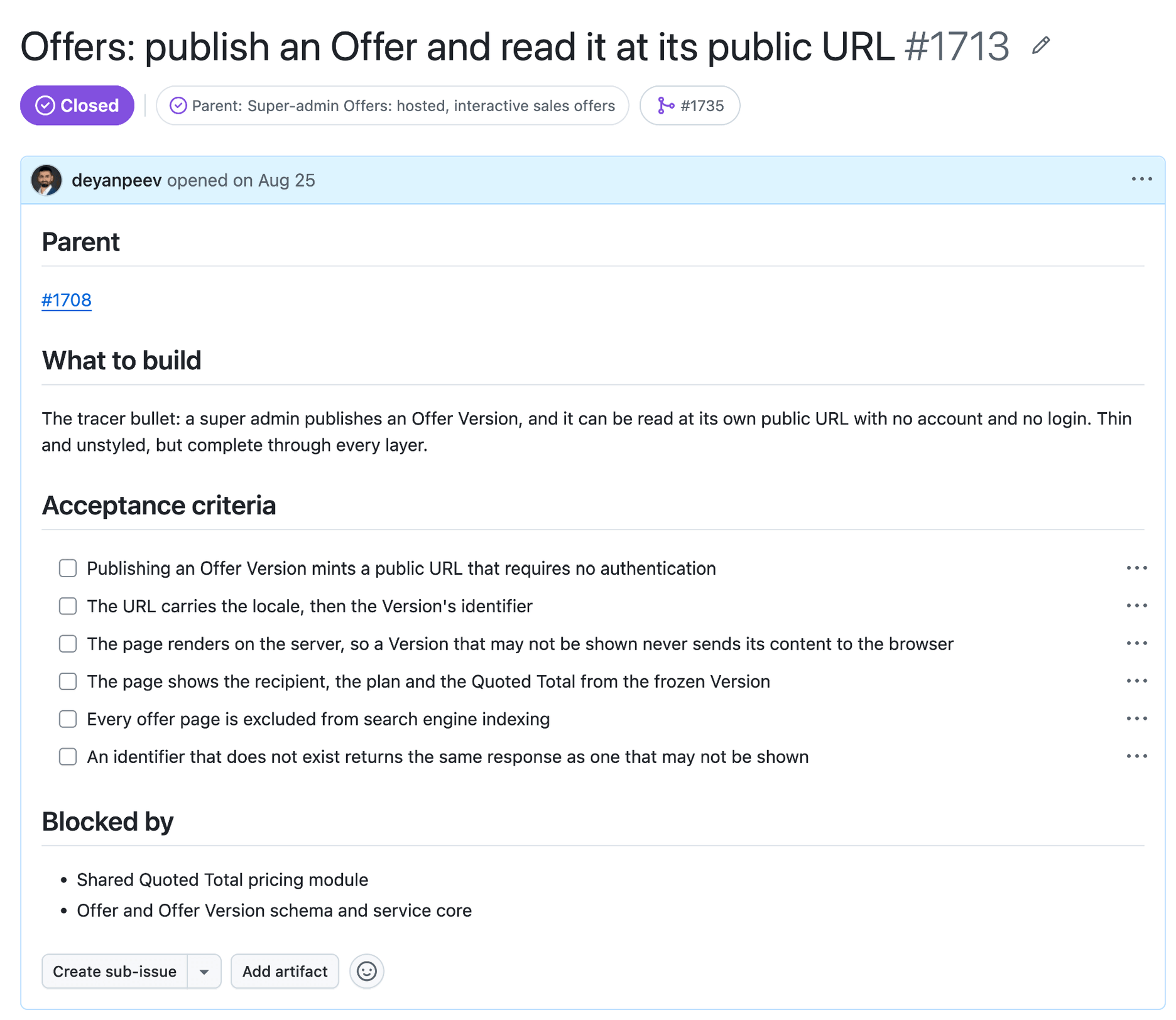
the testing seams and what is out of scope. /to-tickets cut it into tracer
bullets. A tracer bullet is a thin vertical slice that goes through every
layer, rather than a "do the database" ticket followed by a "do the UI" one. It
proposed 16 slices with a graph of which blocks which. I removed the ticket for
retiring the old tool, removed a dependency that was not a real blocker, and
added custom add-ons and free-text blocks. Then I typed "go".
It created four labels and the spec issue, then sixteen tickets, #1709 to #1724.
Each one is a sub-issue of #1708 with native "blocked by" links, and each is
labelled ready-for-agent.
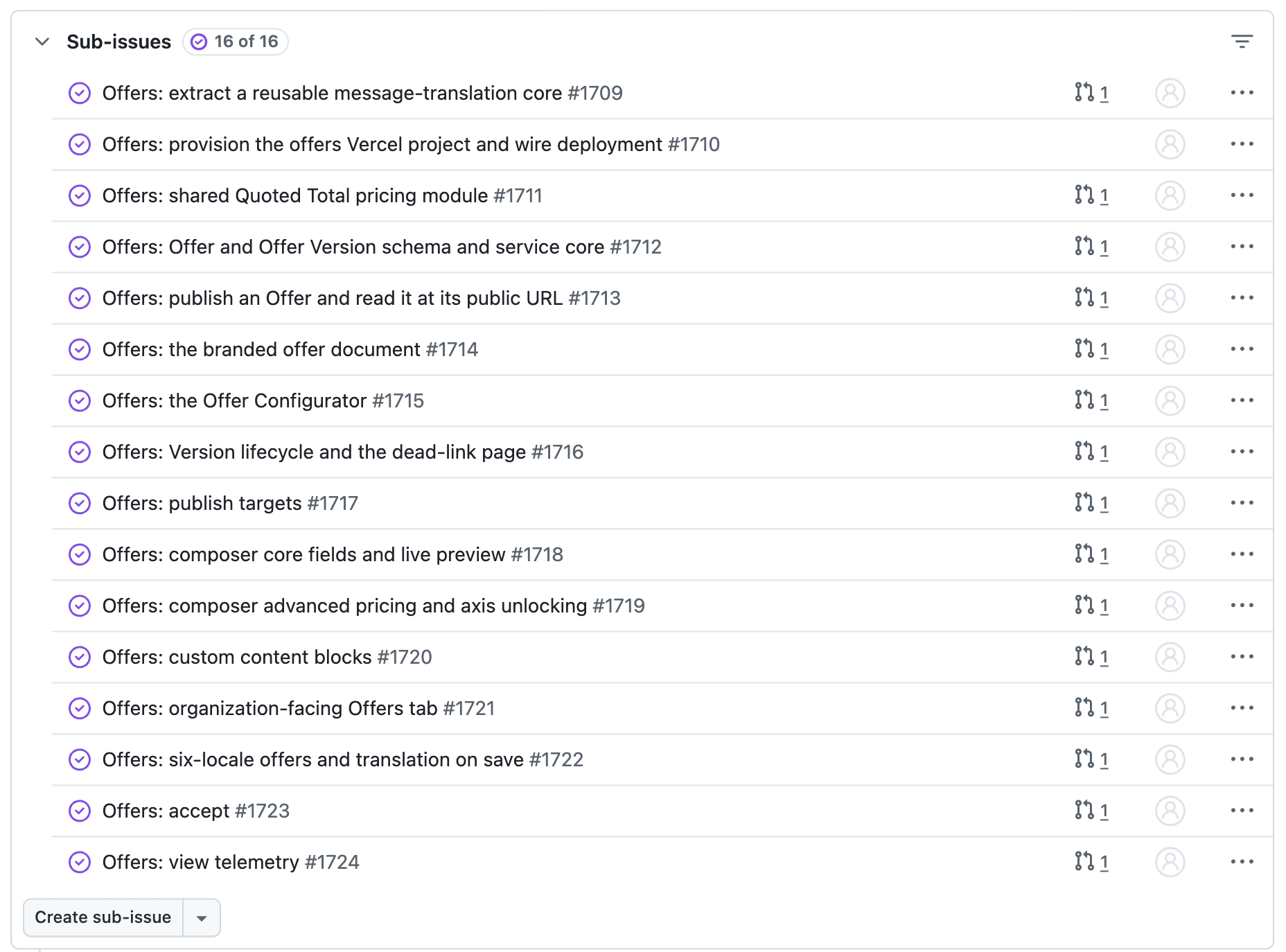
Every ticket uses the same template: the parent, what to build, acceptance criteria and what blocks it. This is the tracer bullet:
Not all of it went cleanly:
- A shell word-splitting bug put thirteen wrong blockers on #1712. Claude noticed, removed them, rebuilt the graph and read it back from the GitHub API to check.
- Earlier, it had told me it had fixed a line in the spec file. Later it corrected itself: "I hadn't; I only said so."
Both were caught in the same session. Both would have been a problem in a process that trusts the output without reading it.
Building from the issues
I ran /implement with no arguments and it found #1708 on its own. The skill
works test-first where it can. Then it runs /code-review along two axes: does
the code follow the repository's standards, and does it do what the ticket
asked. The spec reviewer earned its place on the first day. A refactor of
the translation code had been declared behaviour-preserving on the strength of
a test that could not fail. With that change, a bad model response would have
written English into another language's copy.
One of my decisions did not fit the tooling. I wanted Offers to reach main as a single release, not as sixteen separate merges, so the ticket PRs went into an integration branch, PR #1735. Claude's reply to that included "The dependency graph is now lying." GitHub clears a blocker when the blocking issue closes. An issue closes when its PR merges into the default branch, and nothing merged into the default branch until the very end. Finished tickets kept everything after them looking blocked. From then on I closed tickets by hand as their PRs landed on the integration branch.
The first three tickets were done the next day: the pricing module, the translation core, and the schema with its service. The tracer bullet and the branded document followed in mid-September. The remaining nine went in one session: 52 files and about 4,700 lines, in PR #2120 on the 18th. It all merged to main on Wednesday.
The feature, layer by layer
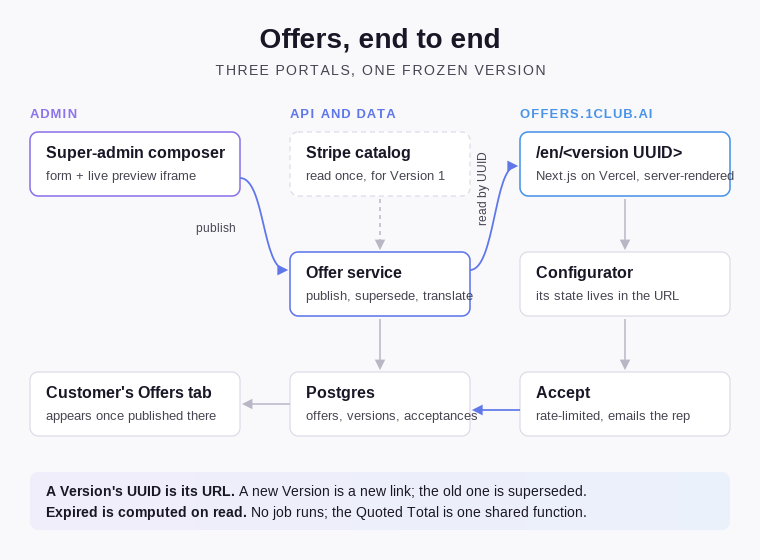
The model. An Offer belongs to one recipient and holds no prices. Prices
live on its Offer Versions. A version is a frozen snapshot of prices, features,
add-ons and copy, with its own validity date. Its UUID is the public URL, so a
new version is a new link. A version is stored as draft, published or
superseded. Expired is worked out when the page is read, by comparing the
validity date with today, so nothing has to run at midnight. Publishing has two
independent targets, the public link and the customer's admin, and the admin
target only exists once an organization is linked.
The money. The Quoted Total is one pure function, shared by the server's first render and every click on the public page, so the two can never disagree. It takes the per-location price for the member tier, multiplies it by the locations, and adds the add-ons at face value. Multi-year discounts apply to the plan price only. All the arithmetic is done in minor units, so 19.99 × 3 comes out as 59.97.
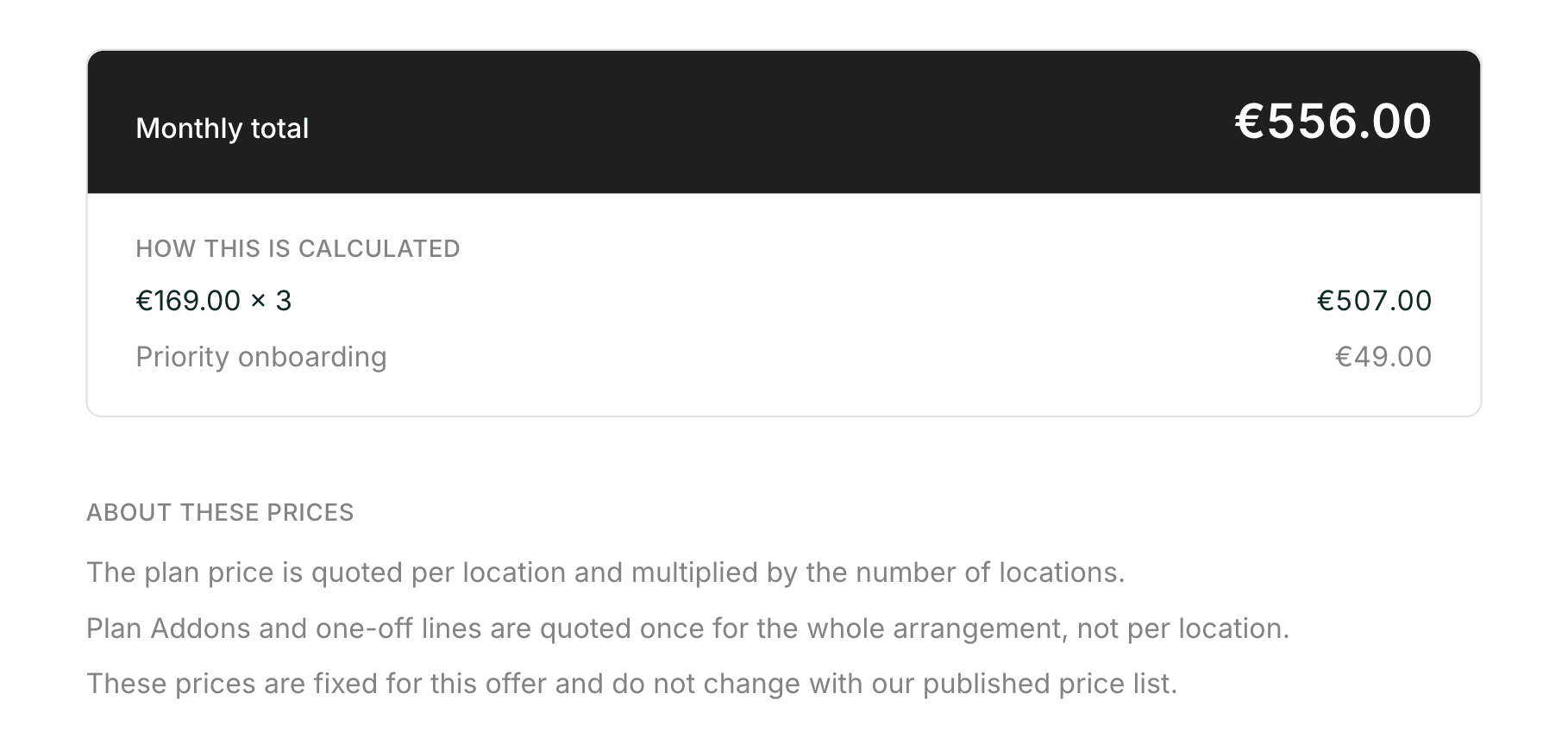
The public page. offers.1club.ai is its own Next.js app. It renders on the
server, so a version that may not be shown never sends its content to the
browser. An unknown ID, a superseded version and an expired one all get the same
"no longer available" page. The prospect's configuration lives only in the URL,
so a configured offer can be forwarded as-is. Accepting it records a name, an
email and the configuration on screen, and emails the rep. It charges nothing
and creates nothing. Telemetry is a view count with first and last timestamps,
and nothing per visitor. The rep's free text is machine-translated into the
other five languages on save. Each translation is stamped with a hash of its
source, so a re-save only translates what changed, and copy someone has reviewed
is never regenerated.
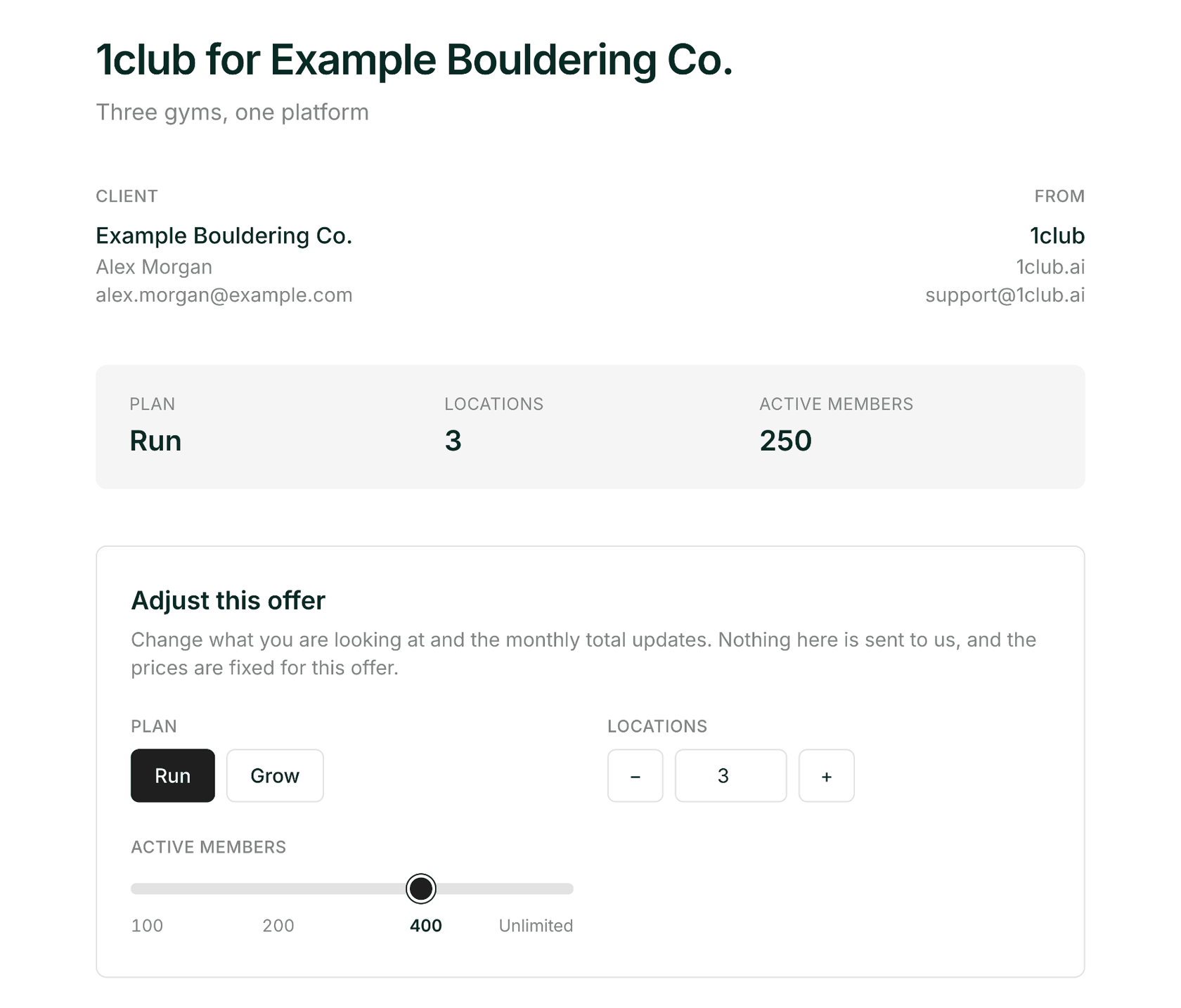
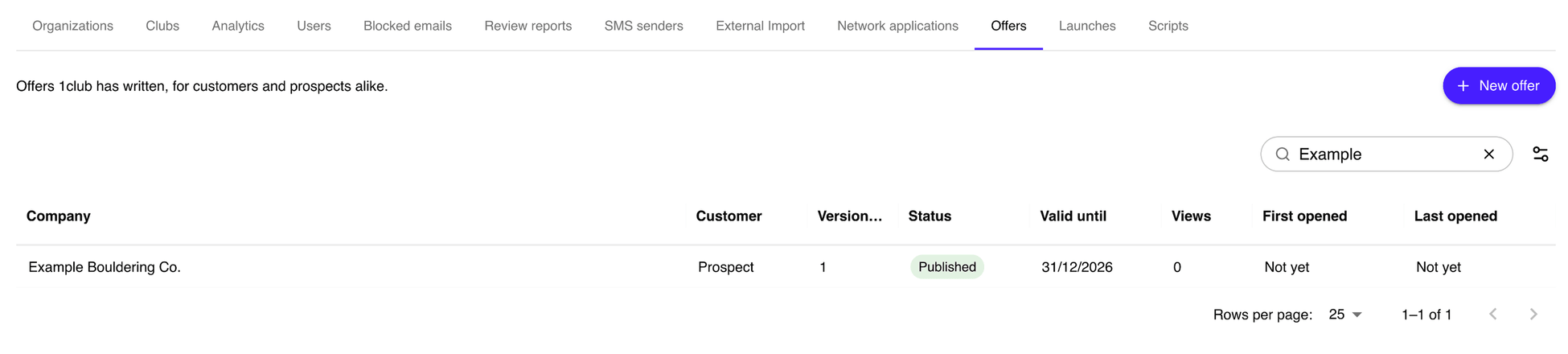
The admin side. The composer is a form with the real offer page running beside it in an iframe as a live preview. The customer's Offers tab only appears once something is published to that organization. Who can see it is decided by the existing billing permission, not a new module.
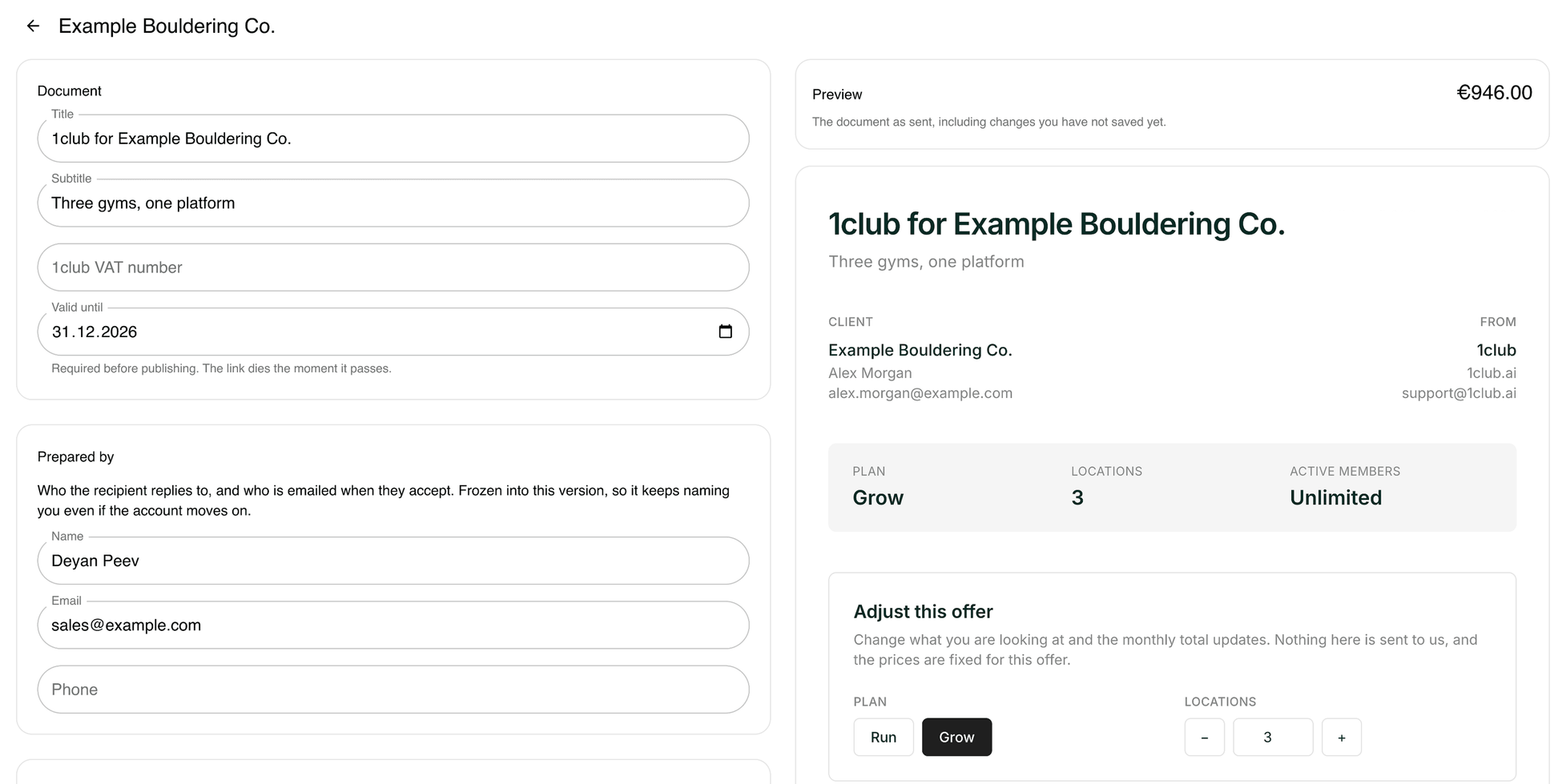
Infrastructure. The offers app has its own Vercel project, created with Terraform in our infrastructure repository and wired into the same staging and promote workflows as the other frontends. Two things broke on the way to production:
- The staging build failed on where the pricing module lived, and the module
moved into the shared
@1club/interfacespackage. - The admin's live preview had to point at the offers host of its own environment, so staging admin now pairs with staging offers.
Below is a working model of the three portals. A demo pointer walks through publishing a version, configuring it as the prospect and accepting it. Click anything to take over.
What I would tell myself on 25 August
The skills compose, but the order is up to you. After the grilling I did not know what came next, and my messages from that afternoon are mostly questions about the process. "so how many tickets will I end up with?" "shall I clear the context beforehand?" Ten minutes later: "ok, how do I clear the context now? Do I clear the context after each implementation?" What worked was:
/grill-with-docs;- set up the tracker once;
/to-spec;/to-tickets;/implementin a fresh session per ticket or group of tickets.
Treat the recommended answers as the strongest case for doing more, and decide for yourself how much of it you want. Two hours of questions feels long around question twenty. Question 28 alone would have cost more than that if it had surfaced after the first offer was accepted.